Filling out the CAO can be intimidating.
Yes, it’s technically true that you’re filling out a form that will have an impact on your third level education (and possibly career). But you can change your mind plenty of times along the way, there are reams of information available on what course to choose, and thousands of students successfully fill out that form and go on to courses they enjoy every single year.
Here’s our guide on tackling that important piece of paperwork. Hopefully this will help demystify the CAO form.
The final year of secondary education has no shortage of stress. We know! We’ve been there too. Between studying for exams and choosing your next steps, there’s a lot to consider. But you can get through it.
For example, the CAO form can be a source of anxiety, but it doesn’t have to be. While it can be intimidating working out CAO points, navigating its website and making big decisions on courses, it’s actually a relatively user-friendly online experience. And you will have the chance to change your mind further down the line, should you want to.
Here is our first-steps guide to filling out that important document.
How to fill out a CAO Application Form
Follow these initial steps closely, and you’ll be on your way to the next step in your academic career.
1. Go to the CAO website.
2. Click the ‘Apply’ button. (You can’t miss it!)
3. Enter details in relevant sections, such as your name, address, date of birth, school(s), and so on.
4. Remember to include all relevant exemptions and/or qualifications (such as language exemptions, for instance).
5. Upon completion of an online application, you will receive a number onscreen (CAO Application code). This number will also be on an email you receive, along with an email verification code.
6. Ensure all your details are correct (such as your PPS).
Your CAO application number
It’s important to remember the importance of your CAO application number. This will be used in correspondences between you and the CAO. Keep that number safe! Take a picture of it on your phone, write it down and stick it up on your bedroom wall or your computer! You’ll be using this number a lot. (Some people remember this number for years after their Leaving Cert!) While we’re on the subject of numbers, you will also need to supply the CAO with your Leaving Certificate exam number. So keep that safe too!
Now, you can log into your account on the ‘My Application’ part of the website. You will be asked your CAO application number, your date of birth and your password.
Choosing Your Course
Choosing your third level course is daunting. For many (if not most) students, what they study at third level impacts their career. But it’s healthier to focus on the positive, less intimidating facts!
Talk to your career guidance counsellor, and to friends or relatives who’ve studied the subjects you’re looking at. Research not just the subjects and careers, but the colleges. Attend as many open days and open evenings as possible.
Remember, you will have the opportunity to change your mind up to May. And even when offers arrive in autumn, there are subsequent rounds of offers.
Do:
- Choose something that interests you.
- Work to your strengths.
Do not:
- Choose a course because you got the points for it.
- Base your course choice on career trends. (Trends change!)
CAO Course Choices and the ‘points race’
Once you complete the Qualifications and Assessments section(s) you can start entering your course choices.
This is an important decision, so take the time to research courses before committing.
Don’t forget, if you don’t get the points for your preferred course, there are other paths to it. PLC (post-Leaving Cert) courses often offer a pathway to degree courses. In fact, as the CAO official guide reminds us, some 20% of degree applications use a Level 5 or Level 6 course to access degree opportunities.
Points demands for PLC and Level 5 and 6 courses trend lower than for degrees. In some cases, admission is based on interviews and/or portfolio (as long as you pass your Leaving Certificate).
You might feel that you’re able to handle a degree in a specific field, but didn’t get the points for it (it’s not uncommon). So, it’s reassuring to know that there is more than one path to that degree.
Minimum Requirements
Don’t forget about ‘minimum requirements’. In other words, some courses require you to pass certain subjects at Leaving Certificate level beforehand.
For example, in DBS, under the new Common Points Scale for Leaving Certificate 2019, applicants need a minimum of 2H5’s and 4 O6/H7 for FETAC/QQI level 8 degrees, including maths and a language. Some, but not all, degree programmes will also require a minimum of O6/H7 in Maths. Entry requirement for FETAC/QQI level 6 & level 7 courses is 5 O6/H7s, to include maths and a language.
(Further Education and Training Awards Council, or FETAC, was superseded by Quality and Qualifications Ireland, or QQI, in 2012. QQI is the national awarding body for further education and training in Ireland.)
Course Lists
You will find two course choice lists (Level 8 and Level 7/6). While you may make up to 10 choices on each list, don’t worry if you can’t fill each space here. Looking at it a little closer, an Honours Degree is Level 8, an Ordinary Degree is Level 7, while a Higher Certificate would be a Level 6.
You may consider each list to be a separate application. In fact, it is possible to receive an offer on both lists, giving you two offers to choose from.
Change of Mind
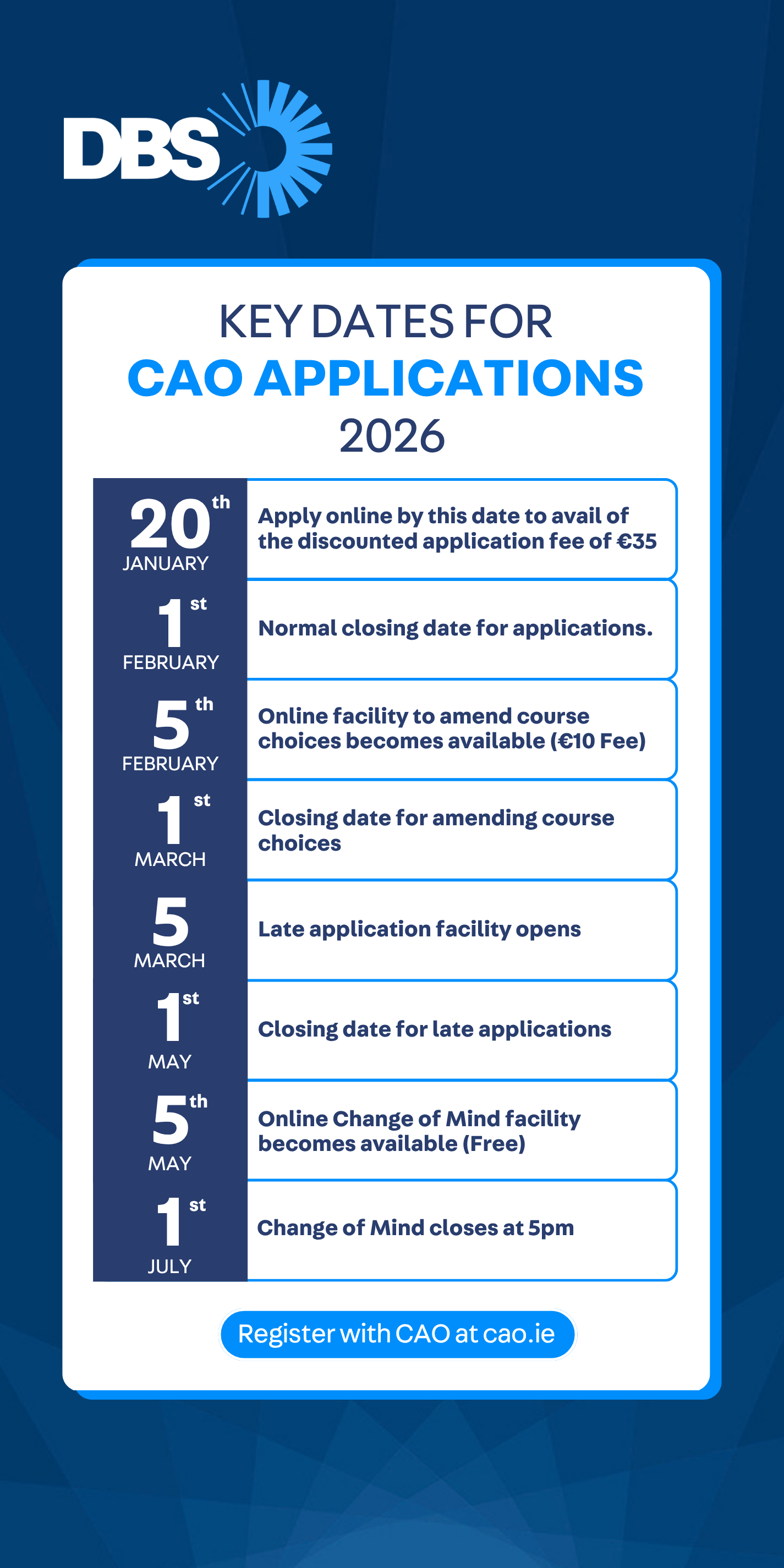
Don’t forget, you will have the chance to change your mind! This can be done by adding, removing or switching courses when the free Change of Mind facility opens in May. The important thing is to get the CAO form filed long before then (in November). Once it’s filed online, you can change it.
Key CAO Dates for your Calendar
Making the Right Choices
Your third level education is a big decision, but thousands of students every year get through the administration and decision-making process, to arrive at the right college for them.
Don’t forget to visit DBS on open events. We will be on hand to answer all your questions about studying at DBS. Check our upcoming Open Events and register here.